
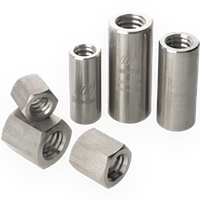
Grade 304/304L Stainless Steel Specification
Grade 304 / 304L stainless steel has a minimum of 18% chromium and 8% nickel.
The only difference between them is the carbon content. Type 304 has a maximum carbon of 0.07% .Type 304L has maximum carbon of 0.030 %. This range of carbon in the steels affects the corrosion resistance. 304 / 304L is available in sheet, sheet coil, plate, plate coil, round bar, processed flat bar and tubular products for further manufacturing.
Applications
Grade 304 / 304L Stainless Steel is used in a wide variety of commercial and industrial applications, including:
- Construction material in building bridges, dams, roads, airports, canals, and buildings
- Nuts, bolts, screws, and other fasteners in the marine environment
- Food processing equipment, particularly in beer brewing, milk processing, and winemaking
- Architectural trim and molding
- Automotive and aerospace structural use
- Chemical containers, including for transport
- Heat exchangers
- Woven or welded screens for mining, quarrying & water filtration
304 Related Specs and Trade names
- EURONORM: 1.4301
- ASTM/ASME: UNS S30400
- BS 304S31
- AFNOR Z2 CN 18-10
- EN, DIN,UNI X5CrNi 18-10
- Grade 304
- Alloy 304
- Type 304
304L Related Specs and Trade names
- EURONORM: 1.4307
- ASTM/ASME: UNS S30403BS 304S11
- AFNOR Z2 CN 18-9
- EN, DIN,UNI X5CrNi 18-9
- Grade 304L
- Alloy 304L
- Type 304L
Corrosion Resistance
- Resistance to moderately aggressive organic acids is a result of the 9 to 11% nickel that the 304 alloys contain.
- Resistance to corrosion in oxidizing environments is a result of the 18 to 19% chromium that the 304 alloys contain.
- At times, grade 304L may show a lower corrosion rate than the higher carbon Alloy 304; otherwise, the 304 and 304L may be considered to perform uniformly in most corrosive environments.Grade 304L is preferred for use in environments sufficiently corrosive to cause intergranular corrosion of welds and heat-affected zones on susceptible alloys
Heat Resistance
- Good oxidation resistance in intermittent service to 1600°F and in continuous service to 1690°F.
- Continuous use of 304 in the 800-1580°F range is not recommended if subsequent aqueous corrosion resistance is important.
- Grade 304L is more resistant to carbide precipitation and can be heated into the above temperature range.
Welding Characteristics
Excellent welding properties; post-weld annealing is not required when welding thin sections. Two important considerations in producing weld joints in the austenitic stainless steels are:
- avoidance of cracking
- preservation of corrosion resistance
Machinability
The use of chip breakers is advised since the chips can be stringy. Stainless steel work hardens rapidly, heavy positive feeds, sharp tooling, and a rigid set-up should be used.
Chemical Properties
| C | Mn | Si | P | S | Cr | Ni | |
|---|---|---|---|---|---|---|---|
| 304 | 0.07max | 2.0max | 1.00max | 0.045max | 0.03max | min:17.5 max19.5 |
min:8.0 max:10.5 |
| 304L | 0.03max | 2.0max | 1.00max | 0.045max | 0.03max | min:17.5 max:19.5 |
min:8.0 max:10.5 |
Mechanical Properties
The properties quoted below are guideline figures only and should not be used for any design purposes.
| Grade | Tensile Strength ksi (min) | Yield Strength 0.2% ksi (min) | Elongation % | Hardness (Brinell) MAX | Hardness (Rockwell B) MAX |
|---|---|---|---|---|---|
| 304 / 304L | 75 | 30 | 40 | 201 | 92 |
Physical Properties
| Density lbm/in3 | Thermal Conductivity (BTU/h ft. °F) | Electrical Resistivity (in x 10-6) | Modulus of Elasticity (psi x 10-6) | Coefficient of Thermal Expansion (in/in)/ °F x 10-6 | Specific Heat (BTU/lb/°F) | Melting Range (°F)) |
|---|---|---|---|---|---|---|
| at 68°F: 0.285 | 9.4 at 212°F | 28.3 at 68°F | 28 | 9.4 at 32 – 212° | 0.1200 at 68°F to 212°F | 2500 to 2590 |
| 12.4 at 932 °F | 39.4 at 752°F | 10.2 at 32 – 1000°F | ||||
| 49.6 at 1652 °F | 10.4 at 32 – 1500°F |