
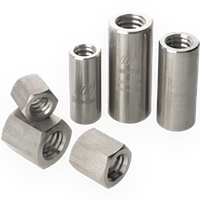
Grade 321 & Grade 321H Specification
Grade 321 is a titanium stabilized austenitic stainless steel with good general corrosion resistance.
It has excellent resistance to intergranular corrosion after exposure to temperatures in the chromium carbide precipitation range of 800 – 1500°F (427 – 816°C). The grade resists oxidation to 1500°F (816°C) and has higher creep and stress rupture properties than grade 304 and 304L. It also possesses good low temperature toughness.
Grade 321H is the higher carbon (0.04 – 0.10) version of the alloy. It was developed for enhanced creep resistance and for higher strength at temperatures above 1000oF (537°C). In most instances, the carbon content of the plate enables dual certification.
Alloy 321 cannot be hardened by heat treatment, only by cold working. It can be easily welded and processed by standard shop fabrication practices.
Applications
- Aerospace – piston engine manifolds
- Chemical Processing
- Expansion Joints
- Food Processing – equipment and storage
- Petroleum Refining – polythionic acid service
- Waste Treatment – thermal oxidizers
Standards
- ASTM/ASME: UNS S32100 / S32109
- EURONORM: 321 / 1.4541
- EURONORM: 321H / 1.4878
Corrosion Resistance
- exhibits good general corrosion resistance that is comparable to 304.
- developed for use in the chromium carbide precipitation range of 1800 – 1500°F (427 – 816°C) .
- can be used in most diluted organic acids at moderate temperatures.
- can be used in pure phosphoric acid at lower temperatures.
- can be used in up to 10% diluted solutions at elevated temperatures.
- resists polythionic acid stress corrosion cracking in hydrocarbon service.
- utilized in chloride or fluoride free caustic solutions at moderate temperatures.
- does not perform well in chloride solutions, even in small concentrations, or in sulfuric acid service.
Processing
Grade 321/H can be easily welded and processed by standard shop fabrication practices.
Hot Forming
- Working temperatures of 2100 – 2300°F (1149 – 1260°C) are recommended for forging, upsetting and other hot working processes.
- Alloy not suitable for work at temperatures below 1700°F (927°C).
- Material must be water quenched or fully annealed after working to re-attain maximum corrosion resistance.
Cold Forming
Quite ductile and forms easily.
Welding
- Readily welded by most standard processes.
- Post weld heat treatment is not necessary
Machining
Hardening rate of 321 makes it less machinable than 410 stainless steel, but similar to 304
Chemical Properties
| Cr | Ni | C | Si | Mn | P | S | N | Ti | Fe | |
|---|---|---|---|---|---|---|---|---|---|---|
| 321 | min:17.0 max:19.0 |
min: 9.0 max:12.0 |
max: 0.08 | max: 0.75 | max: 2.0 | max: 0.045 | max: 0.03 | max: 0.10 | min:5*(C+N) max:0.70 | Balance |
| 321 | min:17.0 max:19.0 |
min: 9.0 max:12.0 |
min:0.04 max:0.10 |
min:18.0 max:20.0 |
max:2.0 | max:0.045 | max:0.03 | max:0.10 | min:5*(C+N) max:0.70 | Balance |
Mechanical Properties
| Grade | Tensile Strength ksi (min.) | Yield Strength 0.2% Offset ksi (min.) | Elongation - % in 50 mm (min.) | Hardness (Brinell) MAX |
|---|---|---|---|---|
| 321 | 75 | 30 | 40 | 217 |
Physcial Properties
| Denstiy lbm/in3 | Coefficient of Thermal Expansion (min/in)-°F | Thermal Conductivity BTU/hr-ft-°F | Specific Heat BTU/lbm -°F | Modules of Elasticity (annealed)2-ps | |
|---|---|---|---|---|---|
| at 68 °F | at 68 – 212°F | at 68 – 1832°F | at 200°F | at 32 – 212° | in tension (E) |
| 0.286 | 9.2 | 20.5 | 9.3 | 0.12 | 28 x 10-6 |